

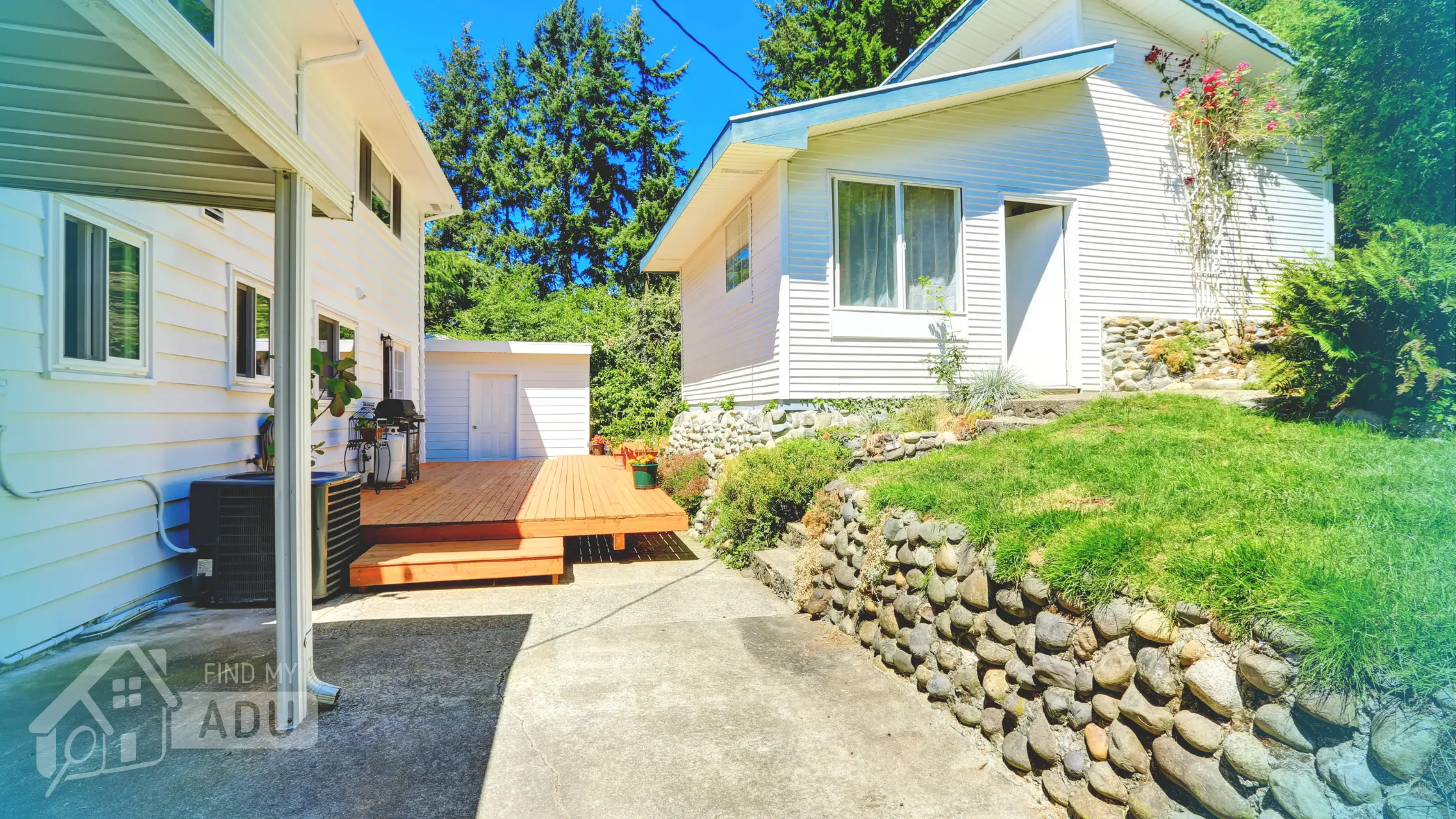
Whether you’re a homeowner or renter in 2026, learning what an ADU is will empower you to make the most of your options in today’s housing market.
So, what is an ADU exactly? An ADU, or accessory dwelling unit, is essentially a smaller secondary home built on the same property as a primary residence.
For homeowners, an ADU means rental income, increased property value, flexible space for hosting others or just a secondary space to use however you want. For renters, they often provide a more affordable and private alternative to traditional apartments or condos.
In this guide we’ll cover what qualifies as an ADU, the different types of ADUs, and get into the “why” behind them.
What does ADU stand for?
ADU stands for accessory dwelling unit. “Accessory” because an ADU is a secondary property on a lot, not the primary. “Dwelling unit” just means a place to live. So, ADU means a separate place to live that’s added onto a lot with a primary residence already on it. (The main residence is usually a house, but can be an apartment building or something else.)
Other common names for accessory dwelling units include in-law suite or in-law unit, granny flat, coach/carriage house, backyard bungalow, and casita. Don’t let the bouquet of nicknames fool you – these all refer to ADUs! There are different types of ADUs that add some distinction, though, and we’ll get into that in a moment.
OK so just to be clear….What is an ADU?
An ADU is an additional residential unit sharing a lot with a main residence.
ADUs are small residences, often the size of a modest one-bedroom apartment – between 800 and 1200 sq. ft. is a typical max allowed by law. They’re fully equipped as self-contained homes in their own right. That means a kitchen, bathroom, living and sleeping areas, as well as electrical and plumbing.
Accessory dwelling units are also required by law to have their own entrance, separate from the main house. So, just because an ADU shares a lot with a main residence doesn’t mean the residents of each will necessarily interact much – the great part is that aspect can be tailored to your situation and preferences.
In practical terms, an ADU means independence—a fully functional home with its own entrance, kitchen, and living space, while sharing a lot with another residence.
Types of ADUs
Accessory dwelling units come in many different forms. If you’re wondering, what is a guest house in someone’s back yard?
That’s absolutely an ADU.
OK well…what’s a garage conversion apartment?
Also an ADU!
Because they don’t all look the same, understanding what an ADU is goes beyond the basic definition. Let’s break it down.
To start, know that they are primarily separated into two types of ADUs: attached and detached. These terms mean exactly what they imply. An attached ADU is physically connected to the main house, while a detached ADU is freestanding on its own.
Also, when it comes to the attached variety, there are some different types of ADUs within that category that are important to distinguish.
Detached ADUs
A detached ADU is “detached” because it’s a completely separate structure from the main residence. While a detached ADU still shares the lot with the main residence (as all types of ADUs do), it is a freestanding building, usually in a backyard or side yard.
The terms backyard bungalow, back house, casita, and guest house all refer to detached ADUs.
What about a tiny home ADU?
Great question! Yes, a tiny house can be an accessory dwelling unit, but it isn’t necessarily one by default. Unlike ADUs, tiny homes aren’t required to share a lot with anything. You can read more on the similarities and differences in our blog about tiny homes vs. ADUs.
Because they’re separate, one of the biggest benefits of detached ADUs for homeowners and renters alike is the privacy. It can be very similar just having a neighbor, if you want it to be.
For homeowners thinking about building, note detached ADUs also tend to be the most flexible in terms of layout and design, since they aren’t constrained by the footprint of the primary house. You can build your own custom ADU, or even buy a prefab ADU to keep it super simple.
For renters seeking an ADU house all your own, detached is definitely the way to go.
Attached ADUs
An attached ADU is built as an extension of the primary home. It shares at least one wall with the main house but, of course, still functions as a fully independent living space with its own kitchen, bathroom, and entrance.
The wall(s) an attached ADU shares with the main house depends on where it’s built. Home additions, basement or attic conversions, and garage apartments are all different kinds of attached ADUs.
One of the benefits of attached ADUs for homeowners is that they’re often a more space-efficient option than detached units, which can mean a lot on a small lot. They also blend into your existing property and are less physically conspicuous than detached units.
When it comes to attached ADUs, there are two common subtypes:
Junior ADU (JADU)
A Junior ADU is a micro unit created within the existing footprint of a home, often by converting a portion of the house, like a bedroom. JADUs are typically capped in size by local law to 500 square feet., so they are typically smaller than the average ADU.
A JADU may also share some facilities, such as a bathroom, with the main home. They may also have an efficiency kitchen–think a mini fridge and hot plate kind of situation. They are designed to be a lower-cost, lower-impact way to add housing to a primary dwelling.
Conversion ADU
Conversion ADUs are created by repurposing existing spaces within the home or other structures on the property into a separate living unit. This might include a garage conversion ADU or a basement conversion. An attic, pool house, shed, or even part of the main floor are all fair game for creating a conversion ADU.
A garage conversion ADU could also be added as a second story above a garage, like The Fonz iconically lived in on the TV show Happy Days. Hm. Okay if we’re talking TV, what about the pool house Ryan lived in on The O.C.? Yah, that one is unclear. It probably wasn’t up to code since they just put him in there suddenly with no notice in the pilot episode. Homeowners, don’t do that! It’s illegal. But yes, that pool house did function as an accessory dwelling unit. Honestly, who’s the criminal now, Sandy Cohen?
… Moving on.
Benefits of ADUs
Now that you’ve wrapped your head around what an ADU is, let’s get into the why and the deeper meaning of ADUs, because there’s a lot there. It’s no secret their popularity has been growing over the last decade, so what are the benefits of ADUs?
Financial
For homeowners, one of the biggest ADU benefits is the opportunity to generate rental income. Putting up an ADU for rent can help offset mortgage payments, bolster retirement savings, or create a steady stream of passive income each month.
There are several options for an ADU rental. Depending on local regulations, homeowners may choose to rent their ADU long-term to a tenant or (less frequently) use it as a short-term vacation rental. In some communities, financial incentive programs are even available for homeowners who rent an ADU unit to low-income tenants.
An ADU rental can also help offset its own construction costs over time. And for homeowners willing to think creatively, there are even more ways to maximize income potential. Some people choose to downsize into their ADU and rent out the main house instead, allowing them to earn significantly more rental income while still remaining on their property.
Beyond monthly income, one of the best benefits of ADUs is that they can also increase overall property value. According to the National Association of Realtors, adding an ADU can increase a home’s value by as much as 35%, making it both a lifestyle investment and a financial one.
The flexibility of an ADU rental caters to symbiotic relationships between renters and homeowners. An ADU unit for rent is a great option for students or professionals such as travel nurses, who may be great renters but not available for a year-long lease.
Lifestyle
ADUs also offer important lifestyle and family benefits. There’s a reason they’re often referred to as “granny flats” or “in-law suites.” One of the most common uses for an ADU is housing extended family members.
Whether it’s an aging parent, an adult child figuring out their next step, or relatives who simply want to stay close by, an ADU unit can be the perfect option. Accessory dwelling units create a balance between togetherness and independence, allowing family members to share a property while still maintaining privacy and personal space.
That flexibility extends beyond family, too. ADUs can function as guest houses for visiting friends or relatives, or provide housing for a live-in caregiver. Having separate living quarters often makes these arrangements more comfortable and sustainable for everyone involved.
Though they legally must be equipped as self-contained living units, ADUs don’t have to be used this way. One of the biggest benefits of ADUs is their flexibility. An accessory dwelling unit can also be a home gym, office, creative space, or simply a little secluded area to chill and decompress.
Community
On a broader level, ADUs can also help expand affordable housing options within existing neighborhoods.
Because they are typically smaller than single-family homes, ADU rentals often cost less than houses or large apartment units in the same area. For renters, this can create a rare opportunity to live more affordably in established single-family neighborhoods that might otherwise be financially out of reach. For many working professionals, an ADU for rent gives them the opportunity to live in the same area where they work.
Many municipalities, especially in California, are facing housing shortages and actively encourage the construction of new ADUs through legislation, to increase the housing supply.
Overall, whether it’s a backyard cottage, garage conversion, or in-law suite, ADUs offer a creative way to make better use of existing space while creating more housing opportunities for homeowners, renters, families, and communities alike.
And as more cities update their zoning laws to support ADU development, these small homes are likely to become an even bigger part of the American housing landscape in the years ahead. So keep your eye out and you’ll be sure to see one coming soon – to a backyard near you! (Or a side yard, or as an addition, or a conversion…)

